-
Theme

Communities & Art
Cultivating grassroots agency and power with creative and accessible methods, peer-learning and global solidarity
-
Theme

Business & Enterprise
Transforming the deep design of business to enable regenerative and distributive action.
-
Theme

Cities & Regions
Local and regional governments working with Doughnut Economics in their policies, strategies, processes and ways of thinking
-
Theme

Schools & Education
Collaborating with educators and learners in all settings to create transformative education for regenerative futures.
-
Theme

Research & Academia
Deepening the concepts and applications of Doughnut Economics through scholarly collaboration.

Discover the Community
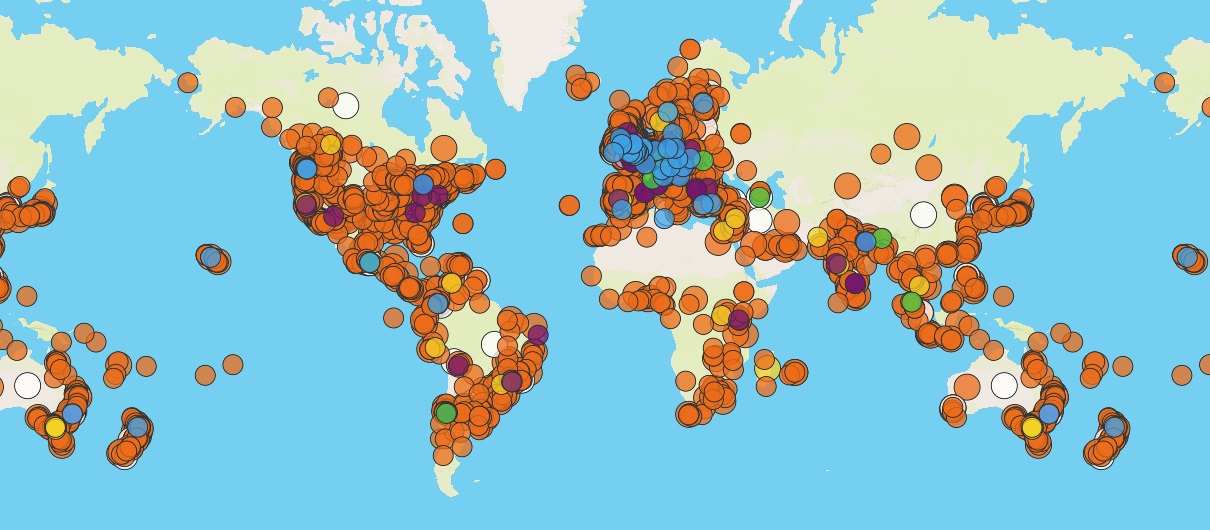
Meet and join a community of pioneering changemakers from across the globe who are turning Doughnut Economics from a radical idea into transformative action.
Welcome to the DEAL Community!
The DEAL Community is everyone who is exploring the ideas of Doughnut Economics and pioneering ways to put the ideas into practice.
This includes educators, policy makers, community members, business people, artists, academics, designers, young people, facilitators, oh, and the occasional economist.
We believe economies of the 21st century will be practiced first and theorised later, and we believe they will be put inspired by the creativity, imagination, skill and perspectives of everyone.
That means everyone is welcome!
What we offer is an open-source commons of inspiration and tools to apply to your context, some created by the DEAL Team, but mostly created by members of the DEAL Community.
What we ask in return is that you use the ideas and tools with integrity, by following our guidelines as we lay out in our guidelines page.

Themes
Explore the six clusters of practice in the DEAL Community where you'll find tools and stories that are most relevant for your audience and context, and events to connect with practitioners like you.
Meet members of DEAL Community
Meet and join pioneering changemakers who are turning Doughnut Economics from a radical idea into transformative action.
-
Member


Purwanto Setiadi
Special Capital Region of Jakarta, Indonesia
I am a co-founder of CommsLab (https://commslab.org), an organization based in Jakarta, Indonesia. We are a communications strategy initiative focusing on coherent and persuasive narratives building by working through public-interest storytelling to strengthen civil society across media, research and movement. Among the narratives we have championed—and which has been a key part of our agenda over the past two years—is a shift in the development model: transitioning from an economy dominated by the extractive sector to one driven by restorative and regenerative activities. We have published a book on this subject, which serves as a resource for sustaining public dialogue. We recently helped organizing a forum in Bangkok, Thailand, themed "Beyond the Haze: How Much More Can We Ask of Our Planet?" featuring Xiaoting Hou-Jones from the DEAL team as the keynote speaker. We spoke with her the day after the event, partly to learn more about DEAL. Consequently, we became interested in joining the DEAL Community.
-
Member

Ben Versh
Maplewood, Maplewood, Essex County, New Jersey, 07040, United States
I am looking to take my professional and life experiences and now express them in service of living my values out loud. I am stirred to action by how we have treated our environment and let so many of our fellow citizens of the country and planet suffer. I have entered graduate studies at the UVM, and I am actively writing and informing my network to bring awareness to the dangers to our society and environment we are letting happen.
-
Member

Zoe Miles
Manchester, Greater Manchester, England, United Kingdom
I am a part of the publicity team in the Post Crash Economics Society committee at the University of Manchester. We are interested in ecological economics and how it can be included within the curriculum to reform economic thought. I study Economics and Politics and am in my final year of university, looking forward to graduating and continuing working towards bettering economic systems for people and the planet.
-
Member

Damián Enrique Jan Cordon
Albalate de Zorita, Guadalajara, Castile-La Mancha, Spain
“I hold a PhD in neuroscience and work at the intersection of social neuroscience, modelling and deliberation. I'm developing "Temperalism with a floor": building agreements from what people already share, while treating the Doughnut's social foundation as a rule that isn't renegotiated. Based in Spain (mainland until December, Tenerife from January). Happy to connect with Spanish-speaking members and anyone working on deliberation, polarisation or local Doughnut projects.”
-
Member

Matt Lindsay
Washington, DC, USA
Matt is a parent, sibling, spouse, and dog owner working to build greater equity, economic opportunity, biodiversity, and harmony with nature. Matt works to advance mission-driven enterprises and organizations through fractional marketing, communications, fundraising, business development, and operations services delivered through his company, Nova*ei. His interest in social impact and lifelong learning brought him to Doughnut Economics and the Doughnut Economics Action Lab. He looks forward to learning and growing alongside other members in this community!
-
Member

Anke Beutel
Berlin, Germany
My vision is reducing textile waste from the very beginning of the collection development. I‘m garment engineer with 20+ years working experience around the garment, specialised in pattern cutting and fabrics. Real body patterns and fabric, which is not brandnew trash are my main focus. Both are levers that could reduce the wastage of resources significantly. This will need a legal framework, such as the REACH regulation for chemicals, to prevent brandnew trash from the market.
-
Member

Marco Eitzen
Asuncion, Región Oriental, Paraguay
I am the vice-director of a non-profit called SERVOME which stands for Servicio Voluntario Menonita. The english translation would be "Mennonite Volunteer Service". It is the social service branch of 32 german speaking mennonite churches across Paraguay. Our vision is to provide help, in the name of Jesus, to people in need so that they can lead a dignified life. The first time I came across the Doughnut was during my international development postgraduate in the University of Amsterdam. I joined DEAL to see if its tools might help measuring the wellbeing of the neighborhoods that churches would like to serve.
-
Member

Ariana Gil
Lakewood, Los Angeles County, California, United States
Hi DEAL community, I’m excited to join you. I’m an organizational change consultant and facilitator who helps people and groups navigate complexity and create meaningful change together. I am interested how humans organize, learn, collaborate, and transform, and how that transformation connect to living systems, sustainability, and more recently, regenerative design in communities. I’m relatively new to the language of Doughnut Economics, but not its spirit, and I’m excited to learn and connect with others exploring these ideas. I’m originally from and live part time in Tijuana, Mexico, and am currently and temporarily based in Long Beach, CA. Outside of work, I love collecting naturalist art and treasures found in the natural world, tinkering, cooking, reading, and dancing.
-
Member

Paul Elliott
Bloomington, IN
My interest in Economics goes back to my school days and my PPE studies at Oxford in the early 1970s. However, I wasn't very satisfied with any of those subjects as a career, so I went into music, which I love, and from 1985 to 2014 taught at Indiana University's Jacobs School of Music. My interest in Politics, Philosophy and Economics has been an interest and hobby all my life, but in retirement I have become increasingly concerned about the direction of travel, and the apparent lack of new ideas, on all sides of the political and economic spectrum, about how to begin to solve the world's most pressing problems. This summer I finally discovered Doughnut (Donut in American English but let's not let spelling divide us) Economics, and the depth, breadth and intelligence of Kate Raworth's vision and hope for the future of the planet! I'm not sure how I can help but I'm going to explore and see what might be possible in my adopted home town.
-
Member

Erin Macnab
Charlotte, Mecklenburg County, North Carolina, United States
Howdy! I am doing my best to soak up this life experience as much as humanly possible, and I would like future generations to have the ability to do the same. Business development is a passion of mine and I strive to lead by example and structure my newest venture in a way that fits the doughnut. I'm a mom of 2 (mostly grown) boys, and the partner of an extremely talented and adventurous landscape photographer. I love gardening, mixed-media art, and slinging free books from my bookmobile - The Kind Bus. I look forward to joining creative conversations that will plant seeds for a future that puts people > profit!!
Organisations & Networks
Groups, networks and institutions putting the ideas of Doughnut Economics into practice and helping others to do the same. Find a group or network in your area and get involved!
-
Organisation / Network

Better Business Network
M3 7FA, Salford, Greater Manchester, England, United Kingdom
Business workshop facilitation
-
Organisation / Network
.png)
Urban Scale Interventions
Portview Trade Centre, Belfast, Northern Ireland BT4 1HR, United Kingdom
Place-based transformation | Government support | Research
-
Organisation / Network

Multigenerational Community - WIELOPOKOLENIOWA.PL
Zabrze, Silesian Voivodeship, Poland
Business workshop facilitation | Place-based transformation | Local project work | Education
-
Organisation / Network

Nanaimo Prosperity Corporation
Nanaimo, British Columbia, Canada
Place-based transformation | Business workshop facilitation | Government support | Convening | Peer-learning | Local project work
-
Organisation / Network

Forum for Urban Informatics
Chennai, India
Place-based transformation | Business workshop facilitation | Government support | Convening | Peer-learning | Local project work | Public speaking | Education | Research
-
Organisation / Network

SIT - Center for Counseling, Social Services and R
Prishtinë, Prishtinë, Prishtina, 10000, Kosovo
Place-based transformation | Local project work | Education
-
Organisation / Network

Oxfam in Korea
Seoul, South Korea
Convening | Peer-learning | Research
-
Organisation / Network

Israel Doughnut Community
Israel
Place-based transformation | Anyone can join
-
Organisation / Network
.png)
Seattle Donut Economics Coalition
Seattle, Washington, United States
Place-based transformation | Anyone can join | Peer-learning | Local project work | Education
-
Organisation / Network

Space2think Ltd
Crediton, Devon
Business workshop facilitation | Education
Local governments in action
Pioneering places around the world are turning Doughnut Economics into practice. Local governments at many scales - from villages to megacities - are adopting the tools and concepts of Doughnut Economics in order to help bring about a thriving future.
-
City / Region

Vienna
Vienna has used Doughnut Economics as one of the guiding principles in their Circular Vienna strategy. In 2026, they are developing their Climate Action Plan (Klimafahrplan), and have been working with the support of local group Doughnut Vienna to develop a Doughnut Portrait that will inform it.
-
City / Region

Épalinges
The municipality of Epalinges in Switzerland, in 2024, began elaborating their Plan of ecological and social transition (PTES) based on Doughnut Economics theory, helped by sustainability specialist BioEco. The Plan, along with the technical report and synthesis of 2 years of work is being published in September 2026, and will include: Epalinges Doughnut data portraits (ideal and political), the Plan of ecological and social transition, vision and objects, action plan with measures etc.
-
City / Region

Waverley
Waverley Council, in Sydney, partnered in a 12-month Regen Waverley program, conducted by Regen Sydney as part of the Council's Thinker in Residence grant. As part of this programme, a community of practice of over 100 local residents, participated in a series of 17 public workshops, aimed at defining a collective vision for regeneration, developing cornerstone indicators for progress, and identifying collective pathways for transition. Doughnut Economics was used as a compass for collective action throughout the program. The Council is now monitoring the indicators, to measure progress towards social and ecological resilience through both Council and community led activities.
-
City / Region

Glasgow
The City of Glasgow has ambitions to move towards a Green Wellbeing Economy in order to meet its social and environmental targets, and has joined C40's Thriving Cities Initiative. An important step in the process of becoming a thriving city is the creation of a (Doughnut Economics) City Portrait, a tool for thinking about Glasgow in a holistic and innovative way. University of Glasgow worked with the city to develop the first City Portrait, as part of the GALLANT project that uses Glasgow as a living lab to trial new sustainable solutions taking a whole-systems approach. In 2023, the Thriving Definitions of the first portrait (the Glasgow Doughnut) were adopted by the council to guide their future work, and to help forge new alliances across Glasgow's many organisations, businesses and individuals across the whole system.
-
City / Region

Valence Romans Agglo
Since 2021, the local government of Valence Romans Agglo have been using the Doughnut as a tracking and monitoring tool for over 20 strategic projects, developing contextualised social and ecological indicators, evaluating the potential impact of these projects and steering their development.
-
City / Region

Tomelilla
After commissioning a study evaluating the possibilities of applying Doughnut Economics in Tomelilla, the town is bringing Doughnut Economics into their work and policies in various ways - by basing their Sustainability Report 2022 on the Doughnut, planning the development of a new school based on the principles of Doughnut Economics, developing a Data Portrait, and exploring the development of an impact assessment and evaluation tool.
-
City / Region

Nanaimo
Nanaimo City’s Council passed a motion to “adopt the Doughnut Economic Model as a cohesive vision for all City initiatives and planning processes”, creating a City Portrait that was blended with their REIMAGINE NANAIMO visioning process. The city has since been using the Doughnut as a unifying framework across the Council, gradually bringing it into a number of policies and strategies - from land use planning, to procurement, to investment.
-
City / Region

Ipoh
In 2022, Perak State launched their 5-year State Strategy that, as one of the strategy’s Flagship Programmes, sets an ambition for the city of Ipoh to be living in the Doughnut, and to use a monitoring framework using the Doughnut.
-
City / Region

Grenoble
The city has launched its ‘2040 Approach’ - a transition path and resilience strategy, which will be using the Doughnut as one of the guiding frameworks, and is about to start a process of developing a City Portrait.
Upcoming events
Upcoming Doughnut Economics events - both online and in-person - by and for the DEAL Community. Have a browse or host your own event!
-
Active Event

GDD 2026 Weekly drop-in
2026-09-10T08:00:00Z
Online
-
Active Event

Regenerative Tourism in Practice
2026-09-14T07:00:00Z
Johannesburg, City of Johannesburg Metropolitan Municipality, Gauteng, 2001, South Africa
-
Active Event

Design for Good Challenge
2026-09-24T22:00:00Z
Online
-
Upcoming Event

#Research-for-Action seminar: What role for tourism in the Doughnut?
2026-10-13T12:00:00Z
Online
-
Upcoming Event

October DE Grassroots Global Connections (Option 1)
2026-10-15T08:00:00Z
Online
-
Upcoming Event

October DE Grassroots Global Connections (Option 2)
2026-10-15T15:30:00Z
Online
-
Upcoming Event
.png)
Peer-learning: Shaping Multilateral Processes for a Regenerative Future
2026-10-16T08:00:00Z
-
Upcoming Event

Can Middlesbrough Truly Thrive? Pathways to Policy—Global Donut Days
2026-10-16T09:00:00Z
Teesside university TS1 3BX, Middlesbrough, Middlesbrough, England, United Kingdom
-
Upcoming Event

[2026 GDDXDonutZip] 도넛경제, 곳곳에서 자라나다. Doughnut Economics is Taking Root
2026-10-20T08:00:00Z
Seoul, South Korea
-
Upcoming Event

DEAL Intersections: where themes meet to cultivate transformation
2026-10-20T08:00:00Z
Online
Tools & Stories
Open access tools that anyone can use to turn Doughnut Economics from a radical idea into transformative action; and inspiring examples and case studies of Doughnut Economics in action in a broad range of places and contexts.
-
Tool

Step Into The Doughnut v2.0 (now in 30 languages)
An accessible and engaging way to introduce the Doughnut to any group
-
Tool

What is a Doughnut Portrait? And how to make one
A guide to help you plan and make a Doughnut Portrait for your place, with your community
-
Tool
.png)
Doughnut Design for Business - Core Tool
DEAL’s guide to redesigning businesses through Doughnut Economics - Core workshop
-
Tool

Cities & Regions: Let's Get Started [4 languages]
A guide for local governments to engage with Doughnut Economics, including 12 case studies, available in EN, FR, SP & PT
-
Tool

Doughnut Economics for University Courses
slide decks, readings, videos & activities for lecturers seeking to integrate DE into their own university teaching
-
Tool

People, People, Planet!
An activity to introduce the Doughnut in a playful way with no props, just people
-
Tool

Doughnut Data Portraits: A Methodological Guide
Guidelines and approaches to 'downscale' the Doughnut by creating a Data Portrait (or City Portrait) for your place
-
Tool

Doughnut Data Portraits: Visualiser & Data Hub
An online platform to visualise place-based social and ecological data using the Doughnut Portrait methodology
-
Tool

Hello Doughnut!
The first set of Doughnut Economics foundational learning tools for schools and education. Welcome!
